

2024-02-20 14:01:34
Guide to Identify Images Generated by Artificial Intelligence, such as the Fake Photos of the Arrest of the Former President
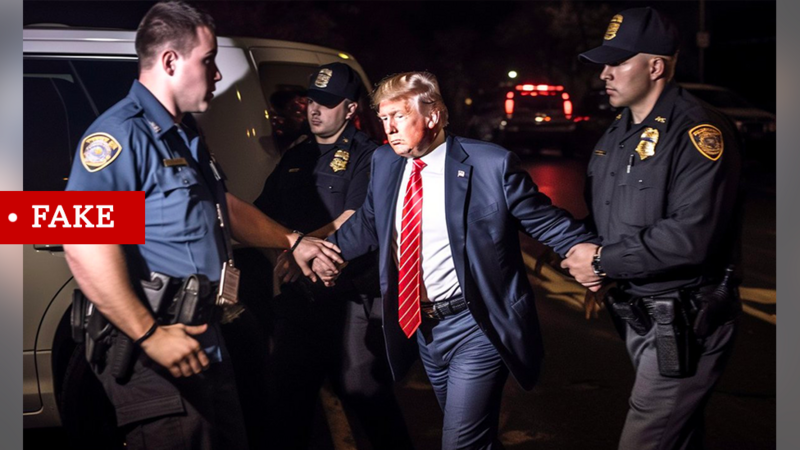
The images that have circulated on the internet, such as the one shown above, have a hyper-realistic appearance, more akin to elaborated artistic shots than photographs captured in the moment. However, a closer examination reveals some obvious clues that something isn't quite right.
By focusing on the image, certain anomalies can be observed. For example, Trump's arm appears too short, and the police officer to his left seems to be grabbing something more akin to a claw than a human hand.
Similarly, upon closely observing Trump's neck, it appears that his head seems to be superimposed onto the image.
Henry Ajder, an AI expert and presenter of the BBC radio series "The Future Will be Synthesised," explains that current technology is not very accurate when representing certain body parts, especially hands.
"If you zoom in on the image, you can often notice inconsistencies, such as the number of fingers," he points out.
What do others say?
A simple search on some trusted news sites is a reliable way to verify if Trump has been arrested or charged, at least up until now.
If Trump were facing charges, it would be headline news worldwide, attracting massive media attention. It would be hard for an event of that magnitude to go unnoticed. It’s important to consider the context in which an image is shared. Who is sharing it, and what might their motivations be?
Often, people share images to back up their political opinions without verifying the authenticity of the photos. It’s crucial to be skeptical and seek reliable sources before accepting any image as true.
More strange details
A more detailed inspection of the photos reveals details that raise doubts.
Unnatural skin tones and faces with wax-like or blurry features are strong indicators that the image might be fake.
In the mentioned image, there is clearly a person with a blurry face in the top right. Additionally, Trump’s hair appears blurry, while his face is sharp.
Henry Ajder, AI expert, notes that we've seen examples of crude fakes in the past, such as the manipulation of a slowed-down recording of Nancy Pelosi to make her appear drunk. Despite being an obvious manipulation, many people were fooled by it, or at least wanted to believe it.
Problems in the future?
AI experts have shared their concerns with the BBC about the rapid pace of progress in the field of generating fake images and the potential for misuse of this technology.
Mounir Ibrahim, a representative from Truepic, a company specializing in digital content analysis, warns that synthetic content is advancing by leaps and bounds, and the difference between the authentic and the fake is becoming increasingly difficult to discern.
While fakes of famous people like Trump may be easier to detect due to their widespread notoriety, images of unknown individuals could pose a bigger challenge. Moreover, with the continuous improvement of technology, the creation of fraudulent images is becoming increasingly sophisticated.
Educational Artificial Intelligence (AI) refers to the use of AI technologies to enhance learning experiences.